
Turning international relocation into lasting retention.
Many organisations invest significantly in recruiting and relocating international talent - only to find engagement drop and people move on within the first two years. Research consistently shows that up to 50% of international assignments end prematurely, and up to 70% of relocated employees underperform, not due to technical skill gaps, but because the integration phase was left unsupported (Derksen, 2026).
The Expat Thrive works with companies to address the critical integration phase that begins after the move: the cultural, social, and practical transition that determines whether an international employee truly settles or starts planning their next move.
The Expat Thrive supports the integration phase that relocation alone cannot cover:
Faster cultural adaptation and workplace confidence
Stability for the employee and their accompanying family
Stronger integration outcomes across professional and personal life
Measurably improved retention of international hires
A consistently positive relocation and onboarding experience
Because a successful relocation is not the same as a successful integration.

The Challenge
International talent often faces invisible integration barriers after relocation:
Unfamiliar communication styles and unspoken workplace norms
Difficulty building professional and social networks from scratch
Uncertainty around German cultural expectations in and outside work
Isolation of accompanying partners and families
The gap between functional language skills and true cultural fluency
Adaptation fatigue in the months following arrival
These hidden challenges directly influence:
Employee retention and long-term commitment to the role
Engagement, motivation, and daily performance
Wellbeing and mental resilience
Cross-cultural team dynamics and collaboration
Partner and family stability, a primary but systematically overlooked driver of early return
Overall return on international recruitment investment
A 2026 study found that accompanying partners receive virtually no structured support during relocation, despite family adjustment being one of the most reliable predictors of whether an employee stays or leaves (Derksen, 2026).

Why This Matters For Employers
According to a 2025 study by Germany's Institute for Employment Research, 26% of immigrants in Germany are actively considering leaving and the most highly qualified are disproportionately likely to do so. In sectors such as IT, finance, and consulting, that figure rises to 39%. The OECD identifies a genuine sense of belonging as the single most protective factor against emigration intention, outweighing salary, job title, and career development. The same pattern is visible globally: research into international assignments across multiple industries found that approximately half of all relocated employees receive no cultural or psychological integration support before or after their move (Derksen, 2026). The logistical side is covered. The human side is not. For HR teams responsible for international talent, this means that retention is increasingly determined not by the offer, but by the experience of settling in.
The companies that retain international talent are the ones that make people feel like they genuinely belong.
How We Complement Existing Relocation Services
The Expat Thrive is designed to work alongside, not replace, your existing relocation and HR infrastructure. While established providers manage the logistical and administrative elements of international moves, we focus on the human integration phase. The layer that existing services do not cover and that has the greatest long-term impact on retention and employee experience.
This includes collaboration with:
Relocation management companies and mobility providers
Internal HR and People teams
Employee Assistance Programmes (EAPs)
Onboarding and talent development functions
Integration support is not a duplication of relocation services - it is the next essential step.
Who Benefits From Our Services
Our programmes are designed for organisations that recruit internationally and are committed to protecting that investment through structured integration support.
Our services are designed for:
internationally recruited professionals in the first 6–18 months post-arrival
Accompanying partners and families navigating life in Germany
International teams working across cultural and communication differences
HR and mobility teams seeking to reduce early attrition in international hires
Organisations building a more inclusive and welcoming international employee experience
When integration is supported properly, international employees contribute more, stay longer, and advocate more strongly for your organisation.
Services
International Talent Integration Support

Structured one-on-one coaching for international professionals in the post-relocation phase.
Covers German workplace culture, professional relationship-building, and practical integration into daily life, giving employees the cultural fluency and confidence to perform and settle from the outset.
Germany Orientation Workshops

Interactive group workshops for international employees or newly arrived cohorts. Participants develop a working understanding of German communication norms, workplace expectations, and cultural dynamics, reducing friction in cross-cultural collaboration and accelerating team integration.
Family & Partner Integration Support

Targeted support for accompanying partners and families. Addresses social integration, practical orientation, and the specific challenges of accompanying relocation, because employee stability is directly linked to family stability. Research shows that partner and family adjustment is among the most significant and most neglected factors in international assignment outcomes. When the accompanying partner cannot navigate daily life independently, the impact on the employee's engagement and focus is direct and measurable (Derksen, 2026).
The Germany User Manual
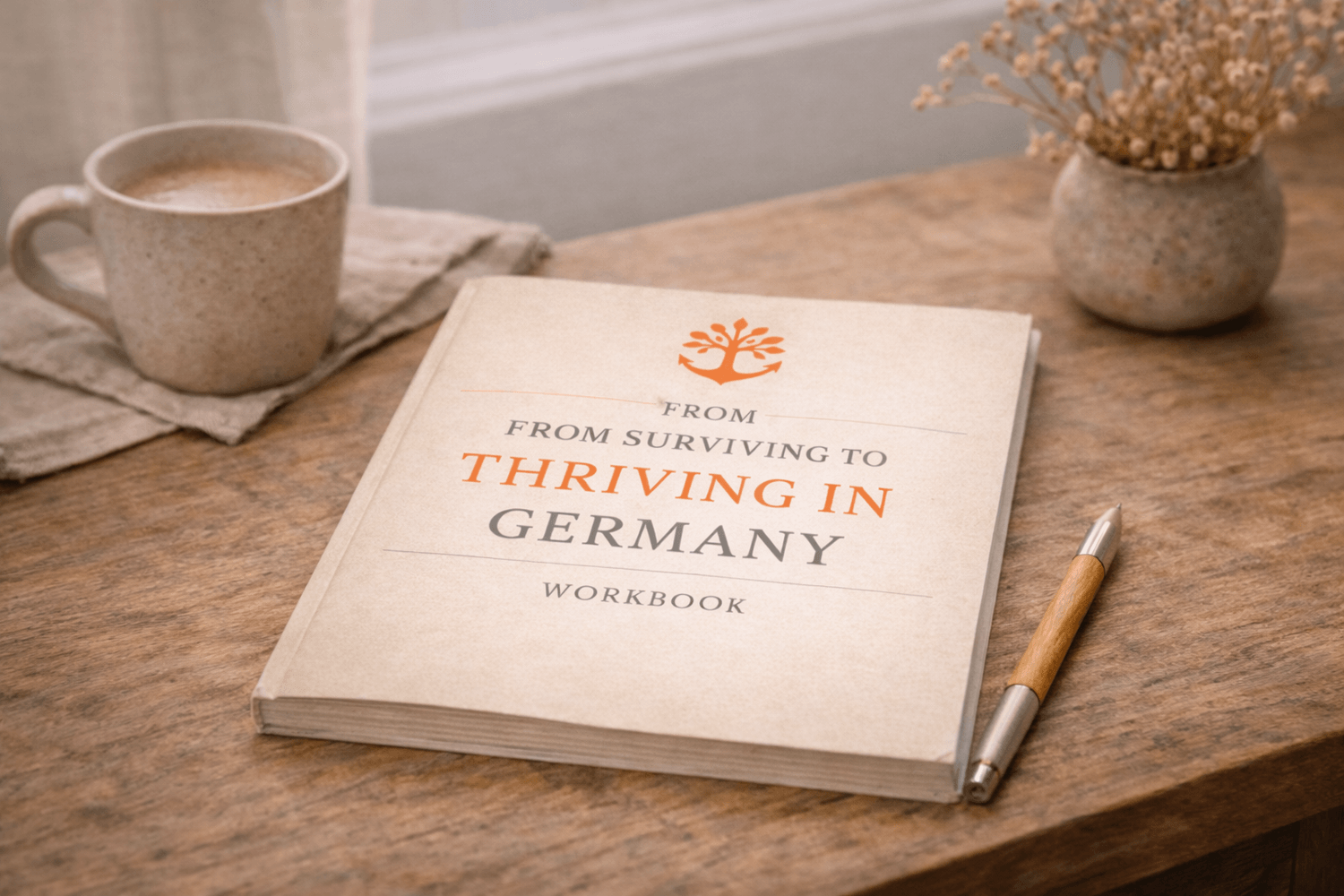
A practical, structured resource covering the cultural, social, and everyday realities of life in Germany that standard onboarding does not address. Designed to be included in welcome packages or used alongside integration programmes.
Why Germany Requires More Than Relocation
Germany has a distinct professional and social culture. A culture that is often experienced as direct and task-focused in communication, yet socially reserved and slow to open up. For professionals arriving from more relationship-driven or informal work cultures, this combination can be difficult to navigate. The gap between arriving in Germany and genuinely feeling at home here is wider than in many comparable destinations, and it rarely closes on its own. Without structured support, international employees frequently find themselves professionally functional but personally isolated - a combination that quietly erodes engagement and, over time, the decision to stay.
The cost of an international hire who leaves within two years, accounting for recruitment, relocation, lost productivity, and replacement, commonly estimated at between €150,000 and €1 million per person, depending on seniority and sector. Structured integration support is not a cost. It's what protects the investment already made.
Organisations that address this proactively retain more, engage better, and build a stronger reputation as employers of choice for international talent.

About Claudia Zielinska
Founder of The Expat Thrive
Claudia Zielinska founded The Expat Thrive with a clear professional purpose: to close the integration gap that costs organisations their best international hires.
Her approach is grounded in direct experience - as someone who has navigated international relocation herself, including expatriation to Istanbul and reintegration into Germany, she brings a practitioner's perspective to the cultural and social challenges that theory alone cannot address.
Experience & Perspective
First-hand experience of international relocation and cultural reintegration
Deep understanding of the specific cultural dynamics of professional life in Germany
A practical, evidence-informed methodology developed from lived experience
A professional focus on integration as a measurable retention and engagement strategy